Why Choose Rigid Core SPC Flooring for Global Projects?
Why Choose Rigid Core SPC Flooring for Global Projects?
Global flooring projects face changing climates, shipping delays, demanding schedules, and different installation conditions. A Rigid Core Spc Floor offers a practical response to many of these pressures. Its stone-plastic composite core provides dimensional stability, while its layered construction supports resistance to moisture, impact, and daily wear. That matters in hotel corridors, retail stores, offices, and residential developments where replacement work is disruptive.
Brett Miller, a respected flooring educator and technical expert, often reminds installers, “The floor covering is only as good as the subfloor beneath it.” This principle remains important for international projects. Rigid core flooring is not a miracle material. Poor subfloor preparation can still cause movement, joint stress, or visible defects. Site teams must check flatness, moisture conditions, expansion gaps, and manufacturer requirements before installation.
Details matter.
A reliable specification should include wear-layer thickness, click-system quality, slip performance, fire testing, acoustic data, and documented environmental claims. Products should also match local building codes and project certification needs. Factory consistency can simplify large-volume procurement, but quality must be confirmed through samples, technical documents, and independent testing where appropriate.
The best choice is not always the cheapest product. It is the flooring solution that performs predictably across locations, installers, and seasons. That requires experience, disciplined inspection, and honest evaluation. Rigid Core Spc Floor can support global projects, but only when product selection and installation planning work together.
SPC Flooring Defined: 4–6 mm Stone-Polymer Rigid-Core Construction
Why Choose Rigid Core SPC Flooring for Global Projects?
SPC flooring uses a 4–6 mm stone-polymer rigid-core construction.
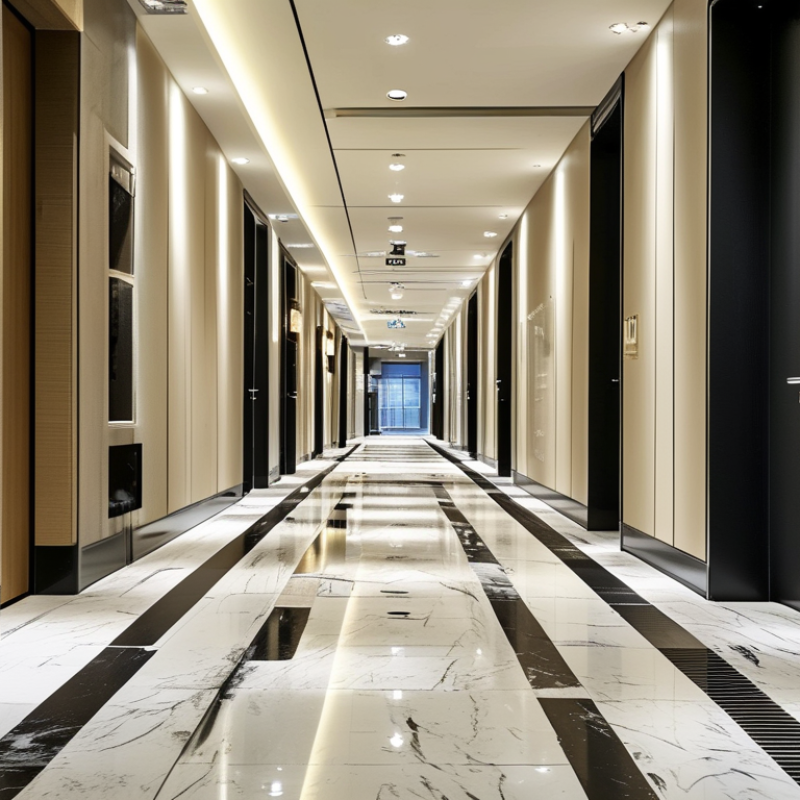
Its mineral-filled core gives each plank strong dimensional stability. In practical installations, this helps the floor resist everyday dents and surface movement. A busy hotel corridor, for example, may receive luggage wheels, wet shoes, and repeated foot traffic. The rigid core provides a firm walking surface under these conditions.
Thickness still matters.
A 4 mm plank can support efficient shipping and easier cutting, while a 6 mm option may feel more substantial underfoot. The wear layer, finish, and locking system also influence long-term performance.
Installers should inspect the subfloor carefully. Rigid flooring is not a cure for deep dips, loose boards, or trapped moisture. Uneven areas can telegraph through the planks.
Global projects often face changing temperatures, different construction practices, and tight installation schedules. SPC planks can simplify phased work because they are generally manageable to handle and install.
Acclimation requirements should follow the project specification, not assumptions. I have seen teams focus on core thickness while overlooking expansion gaps and doorway transitions. That mistake can create pressure points later.
Sound control may also need an underlay or a separate acoustic design. The stone-polymer core is useful, but it is not magic. Performance depends on the complete floor system, skilled preparation, and honest site assessment.
Dimensional Stability: ≤0.15% Change Tested Under ASTM F2199
Why Choose Rigid Core SPC Flooring for Global Projects?
Dimensional stability becomes critical when flooring travels across climates. Rigid core SPC flooring tested under ASTM F2199 showed a dimensional change of no more than 0.15%. This result helps project teams assess movement under defined laboratory conditions. Small movement matters. It can reduce visible gaps, edge stress, and alignment problems across large installation areas.
In practical projects, installers often work near glass façades, heated rooms, or air-conditioned corridors. These spaces may experience repeated temperature and humidity changes. A stable core supports cleaner transitions between rooms and more predictable plank positioning. It also helps simplify planning around door frames, display areas, and long commercial walkways. However, the test does not replace correct installation. Subfloor preparation, perimeter spacing, and acclimation still influence performance.
A responsible specification should review the complete test report, including conditioning methods and sampling details. The ≤0.15% figure is meaningful only when compared with the project’s expected environment. It is not a magic shield. Poor storage or uneven subfloors can still create problems. Details still matter. Experienced teams should verify site conditions before installation and record moisture readings where appropriate. That cautious process makes the laboratory result more useful in real global projects.
Commercial Durability: 0.3–0.7 mm Wear Layers and EN ISO 10874 Classes
Why Choose Rigid Core SPC Flooring for Global Projects?
Commercial floors face rolling carts, entrance grit, spilled drinks, and repeated cleaning. Rigid core SPC flooring offers dimensional stability under demanding daily use. Its stone-polymer core resists compression better than many softer floor structures.
The wear layer deserves careful attention. A 0.3 mm layer can suit lighter commercial areas with controlled traffic. A 0.5 mm layer provides greater protection for busy offices, retail spaces, and hospitality interiors. For heavier circulation, a 0.7 mm layer may offer a longer service window. Thickness alone is not enough.
EN ISO 10874 classes help connect performance with real applications. Class 31 generally fits light commercial use, such as small offices or guest rooms. Class 32 suits general commercial traffic, including shops and corridors. Class 33 supports heavier commercial demands, but site conditions still matter. Some projects need Class 34, where available and properly documented.
From project experience, entrance zones often fail earlier than interior areas. Fine grit behaves like sandpaper beneath footwear. Matting, subfloor preparation, and correct expansion gaps remain essential. A thicker wear layer cannot correct poor installation. This is often overlooked.
We also recommend checking test reports, slip performance, acoustic needs, and cleaning chemicals before approval. Results can vary between products with similar specifications. Global projects require local climate review, installer training, and clear maintenance instructions. A carefully selected floor performs better than an oversized specification.
Global Compliance: EN 14041, ISO 10582, and FloorScore VOC Standards
Rigid core SPC flooring suits global projects because its performance can be checked against recognized standards. EN 14041 supports essential requirements for flooring products placed on the European market. Project teams can review reaction to fire, slip resistance, and formaldehyde information through technical documentation. These details matter in schools, hotels, offices, and healthcare interiors.
ISO 10582 defines requirements for heterogeneous polyvinyl chloride floor coverings. It addresses wear layers, dimensions, classification, and performance characteristics. A reliable supplier should provide current test reports, product specifications, and batch information. Inspect the documents carefully. Small differences between samples and production batches can affect installation results.
Indoor air quality deserves equal attention. FloorScore VOC certification evaluates emissions from flooring and related products under controlled testing conditions. It helps designers assess whether materials support healthier interior environments. However, certification alone cannot solve poor ventilation or unsuitable adhesives. Installation teams should condition planks, check moisture levels, and follow site-specific instructions. Even experienced contractors can miss this step. Climate changes also matter. A product tested in a dry warehouse may behave differently beside a humid coastline. Comparing EN 14041, ISO 10582, and FloorScore evidence gives global buyers a clearer basis for responsible selection. Some documentation may still leave questions unanswered, so independent review is sensible.



 Send Email
 whatsapp
 Whatsapp
