Which Interior WPC Wall Panel Type Is Best in 2026?
Choosing the best Interior Wpc Wall Panel in 2026 depends less on a product label and more on the room, installation conditions, and expected upkeep. A panel that looks convincing in a showroom may feel too glossy beside warm oak flooring. In a narrow hallway, a light, narrow-profile design can make the space feel less confined. In a busy family room, surface texture and scratch visibility may matter more than a dramatic finish.
There is no universal winner. Compare solid-core and hollow-core options, surface coatings, panel thickness, edge details, and the manufacturer’s installation guidance. Check whether the product is intended for interior use, and ask for technical specifications rather than relying on appearance alone. Moisture resistance can be useful near kitchens, but it does not make every panel suitable for direct water exposure. Details matter.
Look closely at samples in the room’s actual lighting. A gray finish can appear blue under cool LEDs, while embossed grain may collect dust in deep grooves. Ask about cleaning requirements, expansion gaps, and compatible trims before ordering. These practical checks help reduce surprises, though they cannot guarantee a perfect result. Even experienced installers can encounter uneven walls or inconsistent batches. That deserves consideration. This guide compares the main Interior Wpc Wall Panel types by appearance, durability, installation needs, and value, so you can judge which trade-offs fit your project—not just which panel photographs best.
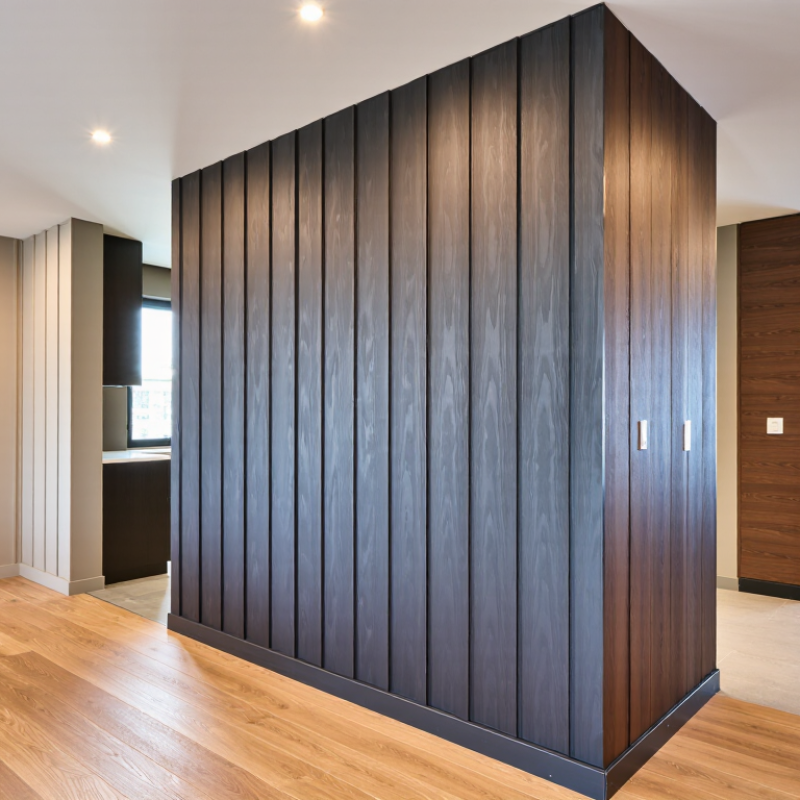
Define Interior WPC Wall Panels by Polymer Matrix, Wood Content, and Core Design
Which Interior WPC Wall Panel Type Is Best in 2026?
Interior WPC panels combine wood fibers with a polymer matrix, but the recipe shapes their performance. PVC-based panels resist moisture well and suit kitchens or laundry areas. Polyethylene blends can feel more flexible, while other polymers may offer different stiffness and surface behavior. Ask for the material specification, not just the label “WPC.” Formulas vary.
Wood content affects appearance, weight, and dimensional stability. More wood fiber can create a warmer, more natural-looking surface, yet it may also increase sensitivity to moisture or uneven temperature. Lower wood content often improves water resistance, but the panel may look less wood-like. Neither choice is automatically better. Check samples under your actual room lighting; a showroom sample can be misleading. Core design matters, too. Hollow cores reduce weight and may simplify installation, while solid or denser cores can feel firmer and help with fastening. Still, a heavy panel is not proof of quality. Confirm the recommended support spacing and fixing method.
Tips: Compare the technical sheet, sample, and installation guidance together. For damp rooms, prioritize tested moisture performance and sealed edges. For a feature wall, inspect the grain pattern and color across several panels. Small gaps can show. I would also check how corners and cut edges are finished, since that detail is easy to overlook.
Compare Hollow, Solid, and Co-Extruded Panels by Durability and Installation
Which Interior WPC Wall Panel Type Is Best in 2026?
Hollow, solid, and co-extruded panels suit different rooms and installation needs. Hollow panels are lighter, easier to carry, and often quicker to fit. Their thin webs, however, can feel less rigid and may offer fewer reliable fixing points. Solid panels feel sturdier around busy hallways, but weigh more and need careful support. They are not automatically more durable; moisture, heat, and installation quality still matter.
Co-extruded panels have a protective outer layer designed to resist stains and surface wear. That layer can help in kitchens or family rooms, though it cannot prevent damage from poor sealing or incorrect expansion gaps. ASTM International’s D7031 guide sets out ways to evaluate WPC physical and mechanical properties; ask suppliers for relevant test results, not just broad durability claims. Grand View Research reported a global WPC market value of USD 7.4 billion in 2023 and projected 11.4% annual growth through 2030. This signals expanding use, not proof that every panel performs equally. Worth remembering.
Tips: Check panel weight, fixing instructions, and test data before buying. Leave the specified movement gap at edges, especially near sunny windows. A small installation shortcut can become a visible seam later. I would compare samples under side lighting, too; surface texture can look different on a full wall.
Evaluate Moisture Resistance, Panel Thickness, and Density for Room Conditions
For a bathroom, laundry room, or kitchen, moisture resistance matters more than a thick-looking profile. The US Environmental Protection Agency advises keeping indoor relative humidity below 60%, ideally between 30% and 50%, to limit mold risk. That is a room-level target, not proof that a panel is waterproof. Check whether the manufacturer reports water absorption or swelling results, and ask which test method was used. ASTM D570 measures water absorption in plastics; results are useful only when the tested material matches the panel’s actual construction.
Thickness and density should fit the wall and the room. A thicker panel may feel sturdier, but it does not automatically resist moisture better. Dense panels can be more rigid, yet density alone says little about edge sealing or the quality of the core. Look for a stated thickness, density, and installation method.
In a steamy bathroom, inspect cut edges and joints closely; moisture often finds those details first. Small gaps matter.
For a dry bedroom or hallway, a lighter panel may be adequate when the wall is flat and well supported. For a splash-prone area, prioritize documented moisture testing and tight, cleanable joints over appearance alone. EPA humidity guidance cannot replace product testing, and test results may not reflect years of poor ventilation. That distinction is easy to overlook.
Check Fire Performance: ASTM E84 Class A Requires Flame Spread Index 0–25
For interior WPC wall panels in 2026, do not choose by color or texture alone. Ask for the exact ASTM E84 test report for the panel and its installation system. Under the International Building Code’s interior-finish criteria, Class A corresponds to a flame-spread index of 0–25 and a smoke-developed index of 0–450. Both figures matter. A panel that meets the flame-spread limit but exceeds the smoke limit may not qualify as Class A.
Read the test details. ASTM E84 measures surface flame spread and smoke development in a controlled tunnel; it does not reproduce a furnished room fire. The National Institute of Standards and Technology’s fire research describes how heat release, smoke, and room conditions affect fire growth—factors that a single surface index cannot capture. Check whether the tested sample matches your panel’s thickness, core, finish, joints, and substrate. Small differences count. Installation matters, too. Ask whether adhesives, trims, and air gaps were included in the tested assembly. A certificate without matching product details is weak evidence. One caveat: even a Class A result does not make WPC noncombustible, and reports can be easy to misread. Have the project’s code professional verify the documentation before specifying the panel.
Screen Formaldehyde Emissions Against the EN 717-1 E1 Limit of 0.124 mg/m³
For a 2026 interior WPC wall panel, start with measured emissions, not a “low-odor” claim. EN 717-1 specifies a chamber method for measuring formaldehyde release; the E1 reference limit is 0.124 mg/m³ under the relevant European panel classification. Ask for a report that names the tested panel, method, result, and test date. A generic certificate may not represent the exact product or finish being installed. Small details matter: edge treatments, surface films, and adhesives can affect what enters the room.
Screening benchmark
Use 0.124 mg/m³ as a screening benchmark, while checking which standard applies to the specific WPC product. The World Health Organization’s 2010 indoor-air guidelines set a formaldehyde guideline of 0.1 mg/m³ over 30 minutes.
These figures are not directly interchangeable: the test conditions and averaging periods differ. Still, the comparison is useful context. Ask whether testing covered the complete panel assembly, not just a raw core. A lab number is not the whole room. Ventilation, installation materials, and other interior products also contribute. I would look for a recent, traceable laboratory report—and admit that even a strong result cannot predict every home’s air quality.



 Send Email
 whatsapp
 Whatsapp
